

What Are Clamps
A clamp is a fastening device used to hold or secure objects tightly together to prevent movement or separation through the application of inward pressure. In the United Kingdom the term cramp is often used instead when the tool is for temporary use for positioning components during construction and woodworking; thus a G cramp or a sash clamp but a wheel clamp or a surgical clamp. There are many types of clamps available for many different purposes. Some are temporary, as used to position components while fixing them together, others are intended to be permanent. In the field of animal husbandry, using a clamp to attach an animal to a stationary object is known as "rounded clamping." A physical clamp of this type is also used to refer to an obscure investment banking term, "fund clamps." Anything that performs the action of clamping may be called a clamp, so this gives rise to a wide variety of terms across many fields.
Efficiency
Hand tools such as clamps are very easy and quick to install, and have high operating reliability. The efficient setup of clamps allows you to work accurately and quickly. As it has high clamping ability, the fixtures that are needed for an application are significantly reduced, thus reducing work time.
Adaptability
Toggle clamps can adapt to work pieces of variable heights. This is especially true for the cam-action model which is often used on rough forgings and castings. T-slot camps and strap clamps have adaptable screws which permits you to apply the desired bracing force. These clamp models have an enormously high exerting force and high adjustability which is very helpful when working with materials of variable thicknesses.
Versatility
Different types of adjustable clamps are available in the market today. Among all the commercial clamps in the market, the toggle clamp is the one that is available in maximum varieties. Handle placement, handle design, and pressure ratings are some of the aspects that distinguish one clamp from another. The clamps are available both in automatic and manual models which allows for an extensive range of clamp actions. These clamps are available in numerous finishes which augments visual appeal and aids corrosion resistance. Some of the common varieties are nickel plated, stainless steel finish, zinc plated and chrome finish.
Improved safety
The design of these clamps promises a high safety level while working. The locking action keeps both the tool and work piece securely in place. This helps in preventing accidents caused due to slipping or loose grip. A toggle clamp allows you to exert a high level of force onto the work piece. While working, the superior holding power of clamps increases the overall safety.




Why Choose Us
Rich experienced
As a leading manufacturer of bathroom hardware products, Yuxinda Metal Products has a highly efficient research and design team that continuously introduces new products with new styles and processes to meet the needs of customers.
Quality control
We also have quality control procedures in place, including regular inspection of raw materials, timed mechanical calibration during production, and unified inspection of products before shipment, ensuring stable quality of our products. We have always been committed to strict quality control and have passed ISO9001 quality management system certification and SGS certification for five consecutive years.
Our service
We provide timely, transparent, and veritable procurement experience for customers. We try and respond to all concerns within 24 hours and our teams are always at your disposal in case of any emergencies.
A strong Logistics system
A strong logistics system can deliver goods all around of world on time. Our main customers come from more than 80 countries and regions such as North America, Europe and the Middle East, and the Repurchase rate remains above 92%.
Types of Clamps



Hand clamps
As the name suggests, a hand clamp is hand-operated. It's designed to hold a workpiece during assembly, welding, machining, and inspection. Popular examples include.
Spring clamp
A spring clamp uses spring tension to hold objects in place. The clamp consists of two pivoting jaws held together by a spring. To use the clamp, squeeze its handles together to open the jaws and place the object between them. The spring tension then holds the object securely in place. Beyond woodworking and metalworking, spring clamps are also useful for holding things like tarps, fabrics, and papers in place, making them a suitable tool for photographers and artists. They are inexpensive, easy to use, and can be found in various sizes and strengths to suit a wide range of applications.
Miter clamp
A miter clamp is specifically designed for woodworking and other crafts involving cutting and joining mitered corners. The clamp typically consists of two metal plates that are joined by a screw mechanism, which allows the adjustment of the angle of the plates to match the angle of the mitered corner. Miter joints can be used to hold everything from picture frames to furniture together, and they are particularly useful for making angled cuts in materials like crown molding and baseboards. To use a miter clamp, first fit the two pieces of wood together at the correct angle and then place the clamp over the joint. Then, adjust the plates to tighten the clamp, securely holding the pieces of wood in place while the glue dries.
Quick action clamp
A quick action clamp has a long bar with two padded jaws on each side; one jaw moves along the bar, and the other is stationary. The clamp's handle is a trigger that moves the mobile jaw closer to the stationary jaw. A lever on the handle allows the moveable jaw to quickly slide across the bar and adjust the distance between the two jaws. Use the lever to get the jaws to approximately the correct distance apart, place the jaws around the workpiece, and then squeeze the trigger to tighten the clamp further. Some quick-action clamps are designed to transform into spreaders by changing the position and orientation of the stationary jaw.
C-clamp
A C-clamp is shaped like the letter "C." The clamp has a flat base, a screw mechanism, and a jaw that can be adjusted to hold objects of different sizes and shapes. C-clamps operate similarly to screw clamps. Using a c-clamp, first position the object to be clamped between the flat base and the jaw, then tighten the screw to hold the object securely in place. One advantage of a c-clamp is that it can be used in tight spaces where other clamps may not fit.
F-clamp
An f-clamp is a type of screw clamp that operates similarly to a c-clamp but has a wider opening.
Screw clamp
A screw clamp uses a threaded screw to apply pressure and hold objects in place. The clamp typically consists of two flat jaws joined together by a screw mechanism. To use the adjustable screw clamp, place the object between the jaws and then tighten the screw to apply pressure and hold the object in place.
Locking clamp
A locking clamp uses a cam mechanism to provide a variable, adjustable clamping force. A cam mechanism is a machine part that transfers rotary motion into linear motion. The cam mechanism of a locking clamp is operated by a sliding handle, which controls the movement of the jaws and the amount of clamping force applied. Locking clamps come in various types, such as straight-jaw, curved-jaw, and needle-nose. They can be used for various applications, including welding, construction, and automotive repair.
Mechanical clamps
Mechanical clamps are simple mechanisms that use four primary components to hold material. These include a toggle handle, clamping arm, linkages, and a base. These devices use mechanical force and are independent of external energy sources.
Bench clamp
One type of a table clamp is a bench clamp, which is mounted to a workbench or table. The clamp consists of a flat base secured to the workbench and a pivoting jaw that can be adjusted to hold objects of different sizes and shapes. Because they are mounted to a bench, bench clamps are more secure than other clamps.
How to Choose Clamps
Type
As well as distinguishing between manual and power clamps, there are other factors to consider. These are usually determined by the space in which the clamp is to be situated and how much manoeuvrability it allows. Levers for manual toggle clamps can be horizontal or vertical, operate with a push or pull linear action, use a rolling cam instead of a pivot, or have a hook instead of a clamping foot. Other types of holding clamp include squeeze-action clamps which work like grippers, and latch clamps. Latch clamps work by placing a hook at the end of the clamping arm around an opposing latch, and pressing the handle down to lock it into position. This type of clamp is seen on old-fashioned kilner jars and swing-top bottles, and is commonly used for sealing covers, lids and doors.
Horizontal or vertical
The horizontal lever holding/toggle clamp is probably the most commonly used, particularly when the machinery has height limitations. It's simple, portable and available in a wide variety of sizes and tolerances. When the handle is up, it's open, and you can place your material under the foot. When the lever is pulled down into the horizontal position, parallel with the base, the clamping arm lowers the foot into position. The final push down of the lever brings it to the locking point, where it cannot be accidentally opened and the material will be held firm. The vertical holding/toggle clamp works on the same principles, except in reverse: The clamp is locked when the lever is up, perpendicular to the base, and open when it's horizontal. This basic lever and fulcrum principle is applied also to push-pull or straight-line clamps, which use the force of the lever to operate the clamp in a horizontal linear motion. In these models, the push/pull handle moves the clamp's plunger back and forth along its axis. Many clamps of this type can be used for both pushing and pulling operations, as they can be locked in two alternative positions.
Size and shape of workpiece
What type of clamp you choose will depend on the size of your workpiece and whether it's a regular or irregular shape. If you're mass-producing one item of a uniform shape and thickness, then you select the clamp that best fits that profile. The amount of force required for your operation will also affect how you choose your holding/toggle clamps. This is determined by the materials you are using and their surface finish. It's also influenced by the machining process as a whole, for tasks such as drilling, milling, bonding, welding, sealing or joining. As far as manual clamps are concerned, there are several variables that contribute to the actual force applied to the holding operation. These include how much force is exerted by the operator on the handle, and where specifically on the handle it is applied. There are also mechanical considerations governing the ratio of force applied between the handle and the workpiece.
Material
Your workpiece materials and their function will also influence your choice. Obviously, for fine delicate materials such as paper, glass or plastic you'll need a smaller clamp than for items such as steel or wood. You'll also need to take into account whether the surface is hard or soft, and polished or unpolished. As far as the clamp itself is concerned, toggle clamps are constructed using a range of modern materials and methods. The frame will usually be made of cast iron or forged steel. Cast iron is very durable and can withstand heavy workloads, while a forged steel frame can hold large or heavy workpieces. The clamping arm, or jaws of the clamp, are most commonly made of steel, which supplies optimal strength under pressure. Full stainless steel mechanisms are also available for food safe and sensitive environments.
The toggle clamp is generally attached to a fixed point, such as a table or jig. Moveable objects can then be placed under the clamp and held securely in position. They comprise a mounting shaft with a pivot pin and flanges where the clamp can be attached to its mounting. A fixed-length lever pivots around the pin in a central mounting, and its action forces the clamping arm open or closed. An adjustable vertical screw is usually mounted on this arm, with a foot made of rubber or some non-impacting gripping material which connects with the workpiece, although often these are modified for bespoke applications. Pressure can be varied, and some types of clamp offer flexibility of adjustment for different workpiece thicknesses. The lever also has a lock point over the central axis which provides a fixed stop and linkage, so that the clamp can't unlock unless this linkage is moved.
Toggle clamps are rated as to their holding capacity, which denotes the maximum force or load they can sustain in the locked position (usually denoted as pounds of force, or lbf). Many machine shops and manufacturers keep a variety of clamps in different sizes so that they can accommodate a wide range of materials and holding power.

Clamp Installation Process

Wedge type tension clamp anchor clamp. This element of suspended reinforcement for self-supporting insulated wire, providing tension support for low-stress conductors on facades and supports made of various materials.
Mounting and dismantling of these fittings do not require the use of special equipment, which greatly simplifies the cable laying. It is designed to quickly and easily attach round fiber optic cables as well as ADSS cables. The distance between the supports can be up to 50 meters. The main advantage of this clamp is the ultra-strong and durable materials from which it is made. This is perhaps one of the strongest and most reliable clamps on the market.
To achieve high quality contacts, it is important not only to choose the right clamps but also to correctly perform the switching. Strip the wires with a special tool that will not damage the wire. Remember to remove the oxide film from the surface. Select the correct liner for proper compression. Pay attention to the insertion of the wire into the terminal block - it should go up to the insulating layer. Test the connection for strength. Provide a small margin of cable length for easy installation to avoid mechanical stress on the terminal block. If a box with terminals is used, be sure to keep the distance between them - this will help to eliminate short circuits when they are possible to heat up.
Remember that, even though switching is a relatively safe and uncomplicated operation, work using wire clamps must be performed exactly according to the above rules. The level of characteristics of the power grid will depend on the reliability of switching, which, in turn, affects the stability of the devices.
How Do I Take Care of My Clamps?
Remove labels from new clamps and wipe clean
Dip a cloth in mineral spirits, and then clean off any adhesive residue from the bar.
Protect the surface with paste wax
Start out new clamps with a fresh coat of paste wax followed by buffing it clean. Thereafter, use wax or oil to maintain the clean surface.
Prevent glue build-up during use
One way to keep glue from building up on your clamp is to place a protective barrier between the clamp and your project’s work surface. You can use a number of items, including painter’s tape, packing tape, parchment paper, and leather.
Clean clamps immediately after use
Once your piece is set, remove the clamps, wipe them down with a dry cloth, and add oil or paste wax as needed. This is especially helpful on moving parts. Remove rust with a spray-on rust remover and steel wool.
FAQ
We're well-known as one of the leading clamps manufacturers and suppliers in China. We warmly welcome you to buy customized clamps at competitive price from our factory. Contact us for free sample.
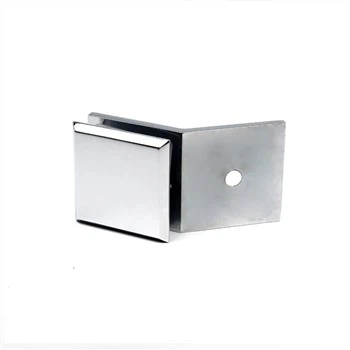
Satin Chromed Wall To Glass Clip, Right Hand Sleeve Over Glass Clamp, Adjustable Sleeve Over Glass Clamp